

Resumption of "Tokyo Waterfront Line" Operations Using Disaster Relief Vessels

To strengthen its disaster response capabilities, the Tokyo Metropolitan Government has built two new disaster response vessels, the “Raiden” and the “Shiranui.” In the event of a disaster such as an earthquake, these vessels will survey conditions along rivers and at disaster response docks, and will transport supplies and personnel as requested by the Tokyo Metropolitan Government’s Disaster Management Headquarters.
Meanwhile, during normal times, the vessels are used to conduct regular inspections of disaster response landing sites and carry out disaster response drills in coordination with relevant wards and other entities. They also serve as venues for public outreach and education to deepen understanding and interest in disaster prevention, waterfront environments, and river management projects.
The Tokyo Metropolitan Park Association will resume operations of the “Tokyo Waterfront Line”—which had been suspended since January Reiwa 8—on Saturday, October 17, Reiwa 8, using the metropolitan government’s disaster prevention vessels. To contribute to the revitalization of water transportation promoted by the metropolitan government, we will offer attractive boat tours along Tokyo’s waterfront, including the Sumida River.
1. Regarding the Operation of the Tokyo Waterfront Line
We are resuming the “Asakusa-Odaiba Cruise,” which has long been popular.
In addition, we are revamping the “One-Day Leisurely Cruise” with a partially revised route, rebranding it as the “Sumida River Leisurely Cruise.” For operations on the Tokyo Waterfront Line, we will primarily use the “Raiden.”
(1) Asakusa–Odaiba Cruise
Enjoy the classic Sumida River cruise, a Tokyo Waterfront Line favorite.
Resumption of Operations
Saturday, October 17, Reiwa 8
Sailing Date
Operates primarily from Wednesday through Sunday.
*Operating days are subject to change depending on weather conditions and other factors.
*For details, please visit the Tokyo Waterfront Line website (link to external site).
(2) Sumida River Leisurely Cross-River Cruise
Take a leisurely cruise along the upper reaches of the Sumida River and the waterfront area to fully enjoy the views of the Sumida River.
*For details on operating days, fares, and more, please visit the Tokyo Waterfront Line website (link to an external site).
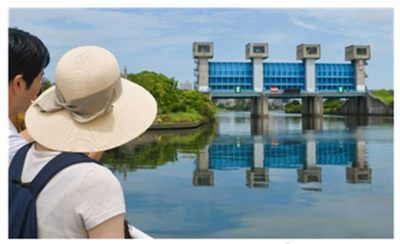
For the time being following the resumption of service, we are running a “Cashless 10% Off Campaign” that offers a great deal on the “Asakusa–Odaiba Cruise.”
Details regarding eligible payment methods and purchase procedures will be posted on the Tokyo Waterfront Line website (“Let’s Take the Water Bus!”), so please check the website (link to external site) for more information.

(3) Main Fares, Schedules, and Routes
Asakusa and Odaiba Cruise
Fare
*One-way fare
| Section | Adults | Little People |
| Asakusa ⇔ Ryogoku | 600 yen | 300 yen |
| Asakusa/Ryogoku ⇔ Odaiba | 2,000 yen | 1,000 yen |
*Children: Ages 1 to elementary school age
*One preschooler is admitted free with each adult
*Infants under 1 year of age are admitted free
Timetable
First Flight
| Time | Boat Landing | Arrivals and Departures |
| 10:40 a.m. | Nitenmon | Issued |
| 10:50 a.m. | Ryogoku | Arrival |
| 11:00 a.m. | Ryogoku | Issued |
| 11:45 a.m. | Odaiba | Arrival |
| 12:00 p.m. | Odaiba | Issued |
| 12:45 p.m. | Ryogoku | Arrival |
| 12:55 p.m. | Ryogoku | Issued |
| 1:05 p.m. | Nitenmon | Arrival |
Second Shipment
| Time | Boat Landing | Arrivals and Departures |
| 1:20 p.m. | Nitenmon | Issued |
| 1:30 p.m. | Ryogoku | Arrival |
| 1:40 p.m. | Ryogoku | Issued |
| 2:25 p.m. | Odaiba | Arrival |
| 2:40 p.m. | Odaiba | Issued |
| 3:25 p.m. | Ryogoku | Arrival |
| 3:35 p.m. | Ryogoku | Issued |
| 3:45 p.m. | Nitenmon | Arrival |
Flight No. 3
| Time | Boat Landing | Arrivals and Departures |
| 4:00 p.m. | Nitenmon | Issued |
| 4:10 p.m. | Ryogoku | Arrival |
| 4:20 p.m. | Ryogoku | Issued |
| 5:05 p.m. | Odaiba | Arrival |
| 5:20 p.m. | Odaiba | Issued |
| 6:05 p.m. | Ryogoku | Arrival |
| 6:10 p.m. | Ryogoku | Issued |
| 6:20 p.m. | Nitenmon | Arrival |
Flight Routes
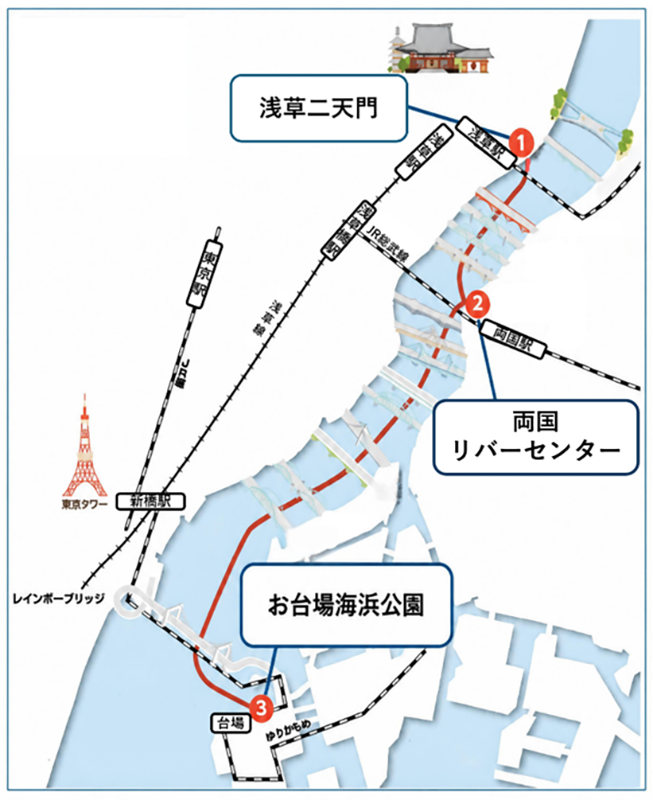
Sumida River Leisurely Cross-River Cruise
*For details such as operating days and fares, please visit the Tokyo Waterfront Line website.
Timetable
First Flight
| Time | Boat Landing | Arrivals and Departures |
| 9:30 a.m. | Ryogoku | Issued |
| 9:40 a.m. | Azuma Bridge | Arrival and Departure |
| 9:45 a.m. | Nitenmon | Arrival and Departure |
| 10:00 a.m. | Senju | Arrival and Departure |
| 10:25 a.m. | Arakawa Amusement Park | Arrival and Departure |
| 10:45 a.m. | Kamiya | Arrival and Departure |
| 11:05 a.m. | Kamiya | Arrival and Departure |
| 11:25 a.m. | Arakawa Amusement Park | Arrival and Departure |
| 11:50 a.m. | Senju | Arrival and Departure |
| 12:05 p.m. | Nitenmon | Arrival and Departure |
| 12:10 p.m. | Azuma Bridge | Arrival and Departure |
| 12:20 p.m. | Ryogoku | Arrival |
Second Shipment
| Time | Boat Landing | Arrivals and Departures |
| 12:45 p.m. | Ryogoku | Issued |
| 1:05 p.m. | Etchujima | Arrival and Departure |
| 1:15 p.m. | Akashi-cho | Arrival and Departure |
| 1:40 p.m. | Odaiba | Arrival and Departure |
| 2:05 p.m. | Akashi-cho | Arrival and Departure |
| 2:15 p.m. | Etchujima | Arrival and Departure |
| 2:35 p.m. | Ryogoku | Arrival and Departure |
| 2:45 p.m. | Azuma Bridge | Arrival and Departure |
| 2:50 p.m. | Nitenmon | Arrival and Departure |
| 3:05 p.m. | Senju | Arrival and Departure |
| 3:30 p.m. | Arakawa Amusement Park | Arrival and Departure |
| 3:50 p.m. | Kamiya | Arrival and Departure |
| 4:10 p.m. | Kamiya | Arrival and Departure |
| 4:30 p.m. | Arakawa Amusement Park | Arrival and Departure |
| 4:55 p.m. | Senju | Arrival and Departure |
| 5:10 p.m. | Nitenmon | Arrival and Departure |
| 5:15 p.m. | Azuma Bridge | Arrival and Departure |
| 5:25 p.m. | Ryogoku | Arrival |
Flight Routes
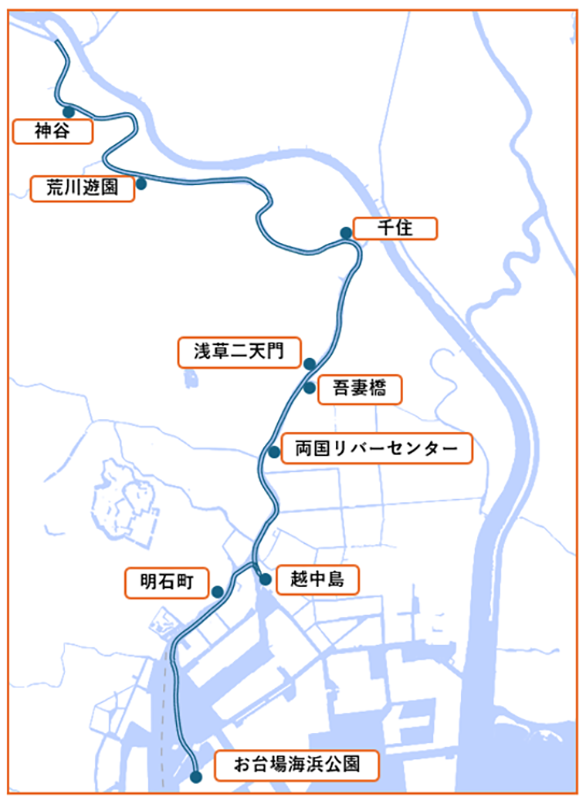
2. (Reference) Overview of Disaster Relief Vessels
Disaster Relief Vessel “Raiden”
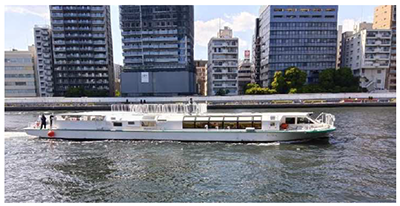
Capacity
Approximately 140 people
Size
Length: 29.8 meters × Width: 7.6 meters; Gross Tonnage: 73 metric tons
Speed
About 19 kilometers per hour
Height above the water surface
2.2 meters
Features
Transporting large quantities of supplies and personnel on rivers such as the Sumida River
Disaster Relief Vessel “Shiranui”
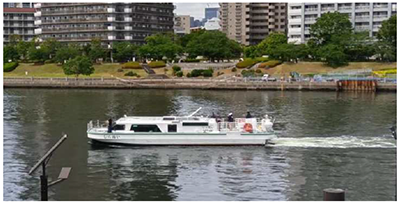
Capacity
About 30 people
Size
Length: 17.5 meters × Width: 5.5 meters; Gross Tonnage: 20 metric tons
Speed
About 19 kilometers per hour
Height above the water surface
2.17 meters
Features
Navigation on Narrow Rivers, Such as Those Within Koto Ward
(1) Roles in the Event of a Disaster
- It will be used to survey conditions at rivers, disaster prevention boat landings, and other locations.
- We will transport supplies, personnel, and other resources in response to a request from the Tokyo Metropolitan Government Disaster Response Headquarters.
(2) Roles During Normal Times
- We will conduct regular inspections of rivers, disaster-preparedness boat landings, and other facilities, as well as disaster response drills.
- We will use this to promote public awareness of disaster prevention and waterfront environments.
- We will operate the “Tokyo Waterfront Line” on the Sumida River and other waterways to help revitalize water transportation.
This initiative is part of the efforts to advance the “Tokyo 2050 Strategy.”
Strategy 17: Community Development and Housing—“Creating a Bay Area Full of Charm and Vitality”
Strategy 18: Infrastructure and Transportation“Enhancing and Strengthening the Public Transportation Network to Support Urban Activities and the Lives of Tokyo Residents”
Strategy 20: Zero Emissions “Expanding the Adoption of Zero-Emission Mobility”
Strategy 21: Urban Resilience “Promoting the Development of Cities That Can Withstand Disasters and Ensure Safety”

| Contact: (Regarding Tokyo Mizube Line) Waterfront Line Section, Waterfront Projects Department, Tokyo Metropolitan Park Association (Public Interest Incorporated Foundation) Phone: 03-5608-8922 (Regarding the operation of disaster response vessels) Bureau of Construction, River Division, Management Section Phone: 03-5320-5408 Email: S0000383(at)section.metro.tokyo.jp *The email address has been changed to prevent spam. Please replace (at) with @ when using this email address. |
その他のお知らせ
-
 Earthquake
-
 Wind and flood damage
-
 Wind and flood damage
-
 Earthquake